
7 Reasons to Think Twice Before Using a ™ Symbol
Why You May Be Setting Yourself Up for Failure—or Worse
By Kary Oberbrunner
I spend a lot of time around entrepreneurs. Anytime someone has a new idea, framework, concept, or slogan, inevitably somebody shouts out, “Better ™ that.”
Of course, they’re referring to slapping an unregistered trademark symbol on it. The belief—or misbelief—is that if you use the ™ keyboard shortcut, you automatically claim intellectual property, similar to someone staking a land claim back in the Wild West by driving a wooden post into the ground.
It sounds smart, but is it?
A deeper dive reveals seven reasons it may be setting up your book, brand, or business for not only failure but perhaps even ultimate destruction.
Sounds melodramatic?
Maybe—unless you’re sitting in court across from a billion-dollar company you accidentally infringed upon because you took your well-meaning entrepreneur friend’s advice. You used the ™ symbol for “IP marking” throughout your website, slide decks, and promotional materials. Unfortunately, that little symbol gave you false confidence and led you to unknowingly pick a fight with a giant in your industry.
The answer isn’t to stop creating IP out of fear. The world needs you to keep innovating. The problem arises when we use IP-marking tools incorrectly.
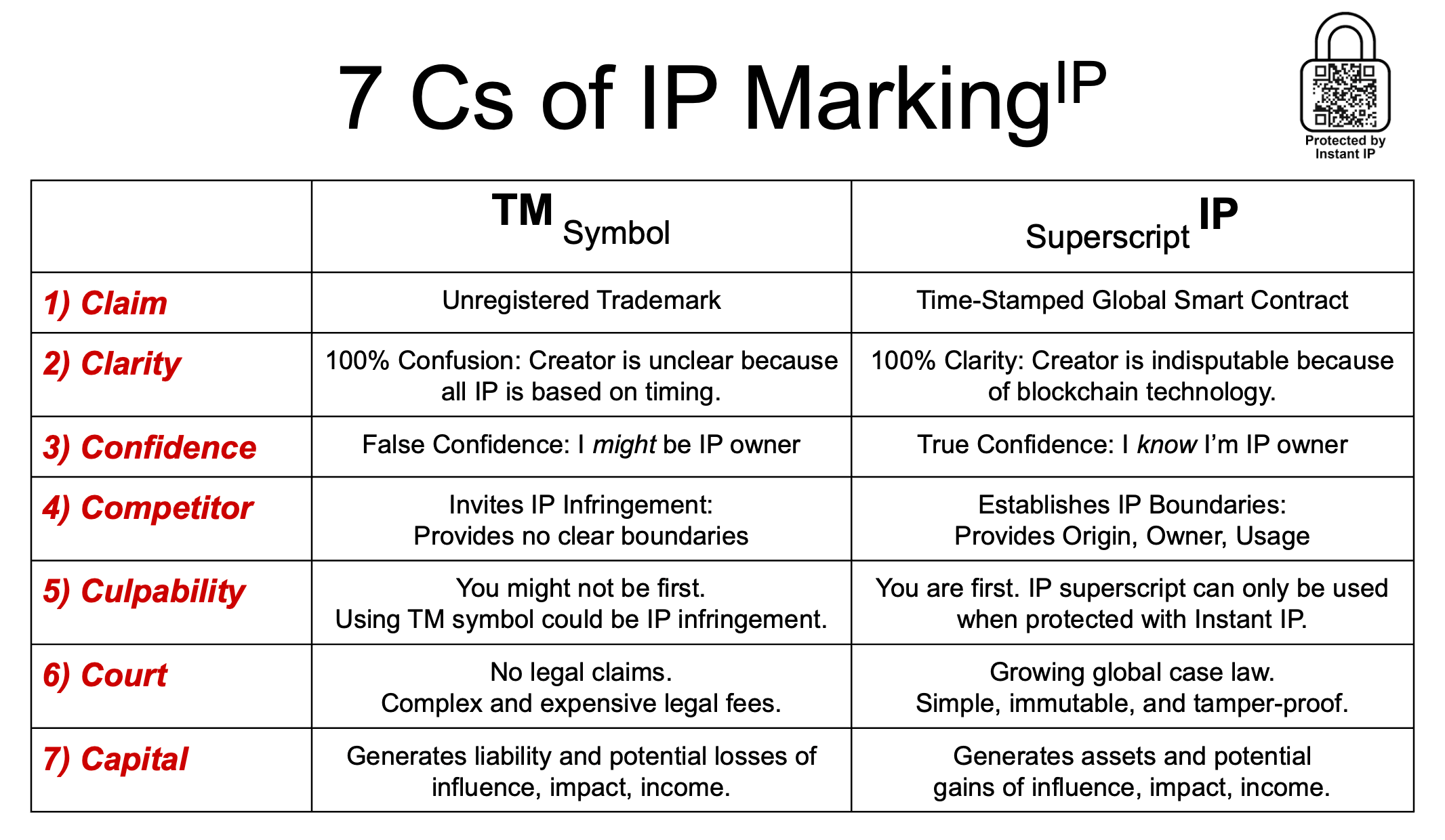
Let’s unpack seven problems a ™ symbol creates, and then explore seven solutions a new form of IP marking provides.
The 7 Problems with Using a ™ Symbol
1. Claim Without Proof
The ™ symbol signals an intent to claim a trademark—not evidence of ownership. There is no built-in verification, no immutable record, and no globally recognized proof of origin. In practice, it’s a declaration without documentation.
2. Clarity Problems
Intellectual property disputes often come down to timing. Who created it first? A ™ symbol answers none of those questions. It introduces ambiguity where clarity matters most—especially in fast-moving markets where ideas spread instantly. With a ™, you aren’t sure whether someone is thinking about registering a trademark, is actually in the process of registering one (the right time to use a ™ symbol), or simply used a keyboard shortcut. In which case, if they did, then who typed the symbol first or who used it in commerce first, and how can they prove it? These answers are subjective, and most lawyers are paid by the hour to help you try to unravel the mystery.
3. False Confidence
Many creators assume ™ equals protection. It doesn’t. That false sense of security can encourage broader use, public exposure, and monetization—before ownership is actually defensible.

4. Competitor Confusion
Ironically, ™ can invite infringement rather than deter it. It can draw attention to your unprotected IP. Without clear boundaries—origin, ownership, or permitted usage—competitors are left guessing. And in IP law, confusion benefits no one except litigators. IP marking exists to protect your intellectual property. When we want to protect physical property, we put locks on doors to keep thieves out. The ™ symbol resembles a lock but does not function as one. If you left your door unlocked and went on vacation, you probably wouldn’t feel secure. The same applies to your business and brand. Unlocked doors invite infringement.
5. Potential Culpability
Here’s the uncomfortable truth: using ™ doesn’t guarantee you were first. If someone else can prove prior use, your public marking could be used against you rather than for you.
6. Court Complexity
When disputes arise, ™ offers little leverage. Cases become expensive, slow, and uncertain—relying on emails, drafts, witnesses, and recollection rather than a single authoritative source of truth.
7. Capital Risk
IP is increasingly viewed as an asset class. In fact, according to S&P, the 500 most valuable companies hold 90% of their assets in intellectual property. Weakly marked IP doesn’t inspire confidence in investors, partners, or acquirers. Worse, it can introduce hidden liabilities that reduce enterprise value. Why leave your most valuable assets up to chance?
The 7 Solutions Provided by Superscript IP
A new category of IP marking is emerging—one designed for the speed and scale of today’s innovation.
1. Verified Origin
Superscript IP begins with a time-stamped, immutable record of creation. Not intent—evidence. Origin is established at the moment of protection, not debated years later.
2. Radical Clarity
When ownership is cryptographically verifiable, ambiguity disappears. Creation dates, authorship, and control are no longer subjective—they’re provable.
3. True Confidence
Confidence doesn’t come from symbols. It comes from certainty. Creators know—not hope—that they are the IP owner, enabling smarter publishing, licensing, and collaboration.
4. Clear Boundaries
Superscript IP defines what competitors need most: boundaries. Who owns it, where it originated, and how it may be used. That clarity deters infringement before it starts.
5. Reduced Risk
Because superscript IP is available only when protection is granted through the patented Instant IP solution, it removes the guesswork—and the accidental misuse—that can expose creators to legal risk.
6. Simpler Enforcement
Courts increasingly recognize immutable digital records as credible evidence. A single tamper-proof source of truth simplifies disputes and reduces dependency on costly legal reconstruction.
7. Asset Creation
Properly protected IP isn’t just safer—it’s more valuable. Superscript IP transforms ideas into defensible, transferable, licensable assets that enhance influence, impact, and income.
A Final Thought
The ™ symbol was designed for a different era—one where ideas moved slowly, markets were local, and proof lived in filing cabinets.
Today, ideas travel at the speed of thought. This is why they must also be protected at the speed of thought. Instant IP was created to enable people to protect their ideas faster than AI or humans can steal them.
Creators don’t need fewer tools. They need better ones—tools that protect without slowing creativity, that clarify without complexity, and that turn ideas into assets rather than liabilities.
The future belongs to those who don’t just create intellectual property—but mark it correctly.