
Protecting Your Ideas: What Actually Works and What Doesn't

- Proof of Creation: Scope, Limits, and the Idea-Expression Distinction
- Documenting Your Ideas: Practical Methods and Common Myths
- Protecting Ideas Without a Patent: NDAs, Trade Secrets and Copyright
- Safeguarding Specific Work: Books, Courses, Frameworks and Products
- How Blockchain Timestamping Works for IP
- Blockchain IP Services: Cost, Speed, Privacy and Reliability
- Legal Standing of Blockchain Timestamps in Court
- Patents: Process, Costs, Timelines and Approval Rates
- Patent Law and First-to-File Strategy
- Choosing the Right IP Protection: Comparisons and Strategy
You came up with something real. Maybe it's a product concept, a method, a creative framework, or an invention you've been quietly developing. Now you're wondering whether jotting it down in an email to yourself, telling a trusted friend, or sealing a description in an envelope is enough to protect it. The honest answer is no, and understanding why leads you somewhere more useful than most legal advice you'll find online.
Proof of creation is the documented record that connects you to an idea at a specific point in time. It sounds simple, but what actually counts as valid proof, how much weight it carries, and what it can do for you when ownership is contested depends entirely on the tools you use and, critically, when you use them. A vague note isn't the same as a detailed written description. A copyright isn't the same as a patent. And a blockchain timestamp isn't the same as either. Each tool does a specific job, and confusing them is one of the most common and costly mistakes creators make.
There's a practical reason this confusion persists. Intellectual property law rewards the prepared and the fast, not just the original. Under the U.S. first-to-file system, the person who files first can establish priority over someone who genuinely invented something earlier. That structural reality changes how you should think about documentation, timing, and which protective layer to reach for first.
What follows is a clear-eyed guide to all of it. You'll learn where copyright's protections begin and where they stop short, which documentation methods actually hold up and which ones waste your time, and how tools like NDAs and trade secrets function before a formal patent exists. You'll also see how protecting a book differs from protecting a software process or a physical product, and why those distinctions matter.
Blockchain timestamping gets a direct examination too: how it works as a proof mechanism, what it costs and how fast it runs, what happens to your privacy, and whether it carries legal weight when it matters most. Then the patent process itself gets laid out plainly, including realistic timelines, costs, and approval realities that the legal industry doesn't always make easy to find.
The first-to-file rule gets its own focused treatment, because grasping it changes your filing strategy in ways that no amount of careful documentation alone can fix. And the guide closes where every creator eventually lands: figuring out which protection fits your specific situation right now, not in theory.
If you've ever felt like IP protection is a subject deliberately kept complicated, this is the practical version. The stakes are real. The tools exist. The path through them is clearer than you've probably been told.
Proof of Creation: Scope, Limits, and the Idea-Expression Distinction
Proof of creation, as established earlier, connects you to an idea at a specific point in time. But knowing what that connection actually covers, and where it stops, is what separates useful documentation from a false sense of security.
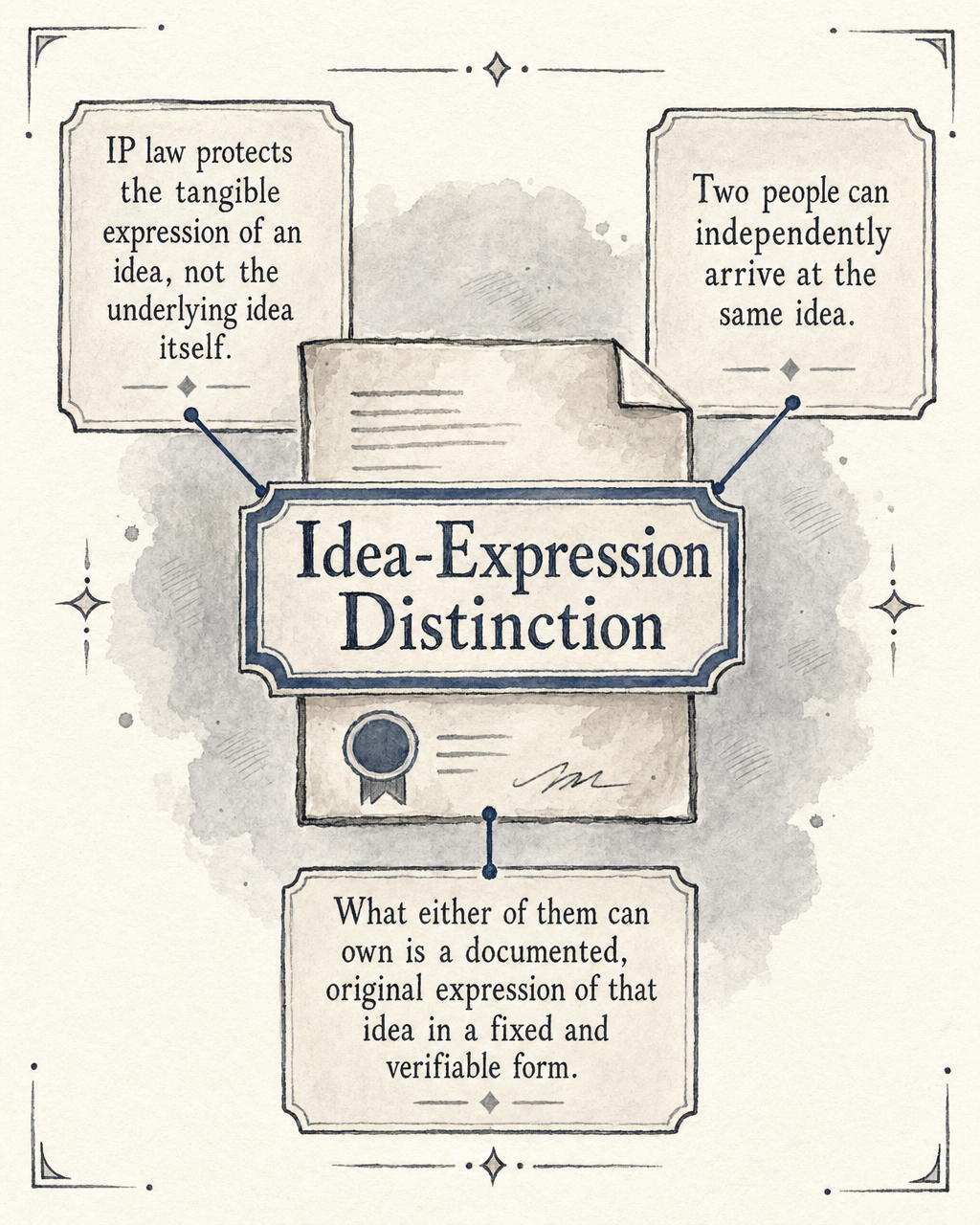
Start with a distinction that trips up nearly everyone: IP law protects the tangible expression of an idea, not the underlying idea itself. This is the idea-expression distinction, and it matters more than most creators realize. If you write a detailed description of a new kind of subscription service, the specific words, structure, and presentation you documented can receive protection. The concept of a subscription service cannot. Two people can independently arrive at the same idea, and neither owns it simply by virtue of thinking of it first. What either of them can own is a documented, original expression of that idea in a fixed and verifiable form.
This is why the belief that "I thought of it first" carries almost no legal weight on its own. Ownership of an idea goes to whoever proves prior documentation first, not to whoever had the earliest flash of inspiration. Under the U.S. first-to-file system, that principle extends further into patent territory: the person who files first can establish priority over someone who genuinely invented something earlier but failed to document or file in time. The race is not about creativity. It is about a verifiable paper trail.
Proof of creation also does not equal registration, and conflating the two is a costly mistake. Documentation creates a record. Registration creates an official one, and in copyright disputes or lawsuits, that distinction often determines whether you can enforce anything at all. A copyright, for instance, exists the moment an original work is fixed in tangible form, but if you need to prove authorship, originality, and the specific date of creation in a contested setting, additional evidence, whether a formal registration, a verified timestamp, or other corroborating documentation, is typically what gives your claim actual weight. Without it, an opponent can challenge your copyright claim in court even when you genuinely created the work first.
A verifiable timestamp on documented content can establish a documentable record of prior existence. In an environment where AI systems are trained on publicly available material, having a timestamped record of when your content existed can be relevant to questions about prior use, though the practical utility in any specific situation depends on broader legal and factual circumstances that are still evolving. Protective measures like notices and blocking crawlers can reduce the risk of future unauthorized scraping, but they do not retroactively affect AI models that have already been trained. [a]
There is also a category of documentation folklore worth naming directly. A sealed, postmarked envelope, sometimes called the "poor man's copyright," may serve as evidence that you possessed something on a certain date. That is its ceiling. It does not constitute registration, it does not give you the enforcement tools that formal registration provides, and any opponent with competent legal advice will say so. The same logic applies to undated notes, informal witnesses, and vague journal entries. They are not worthless, but they are far from the teeth of actual registration or verified timestamping.
What proof of creation gives you is a foundation: a documented, time-anchored starting point that can support your broader IP strategy. What it does not give you is a substitute for choosing the right protection mechanism, filing when filing is required, and understanding which elements of your idea are actually protectable. Those decisions come next, and they depend on knowing which tool fits which situation.
Documenting Your Ideas: Practical Methods and Common Myths
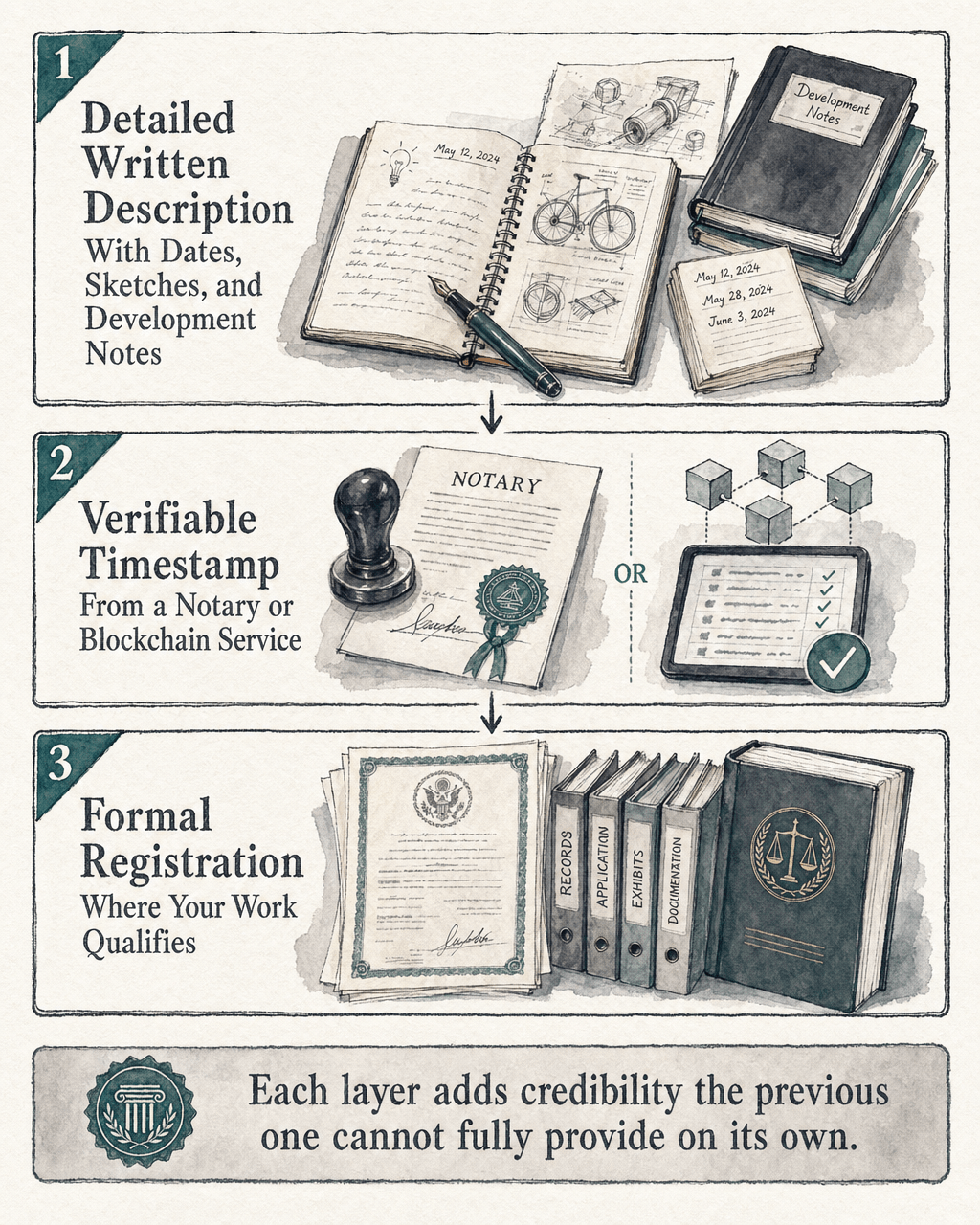
Picture someone carefully sealing a manila envelope, walking to the post office, and mailing it to themselves. They feel satisfied. Their invention is protected. That feeling is the myth.
The poor man's patent and poor man's copyright offer no legal protection whatsoever. A postmarked envelope does not prove you hold the rights to its contents, creates no filing record with the USPTO, and grants no enforceable claim. The USPTO has said explicitly that it is not a substitute for an actual patent. The physical evidence is also easily challenged: envelopes can be steamed open, resealed, or stuffed with new contents after the fact. Courts know this.
So what does work?
Blockchain provides an immutable timestamp
The verifiable timestamp concept covered earlier applies directly here: the goal is a date that comes from an independent source, not from you alone.
With blockchain timestamping, the record it generates cannot be altered without detection, because changing any entry would require rewriting every subsequent block in the chain. That structural integrity is why blockchain proofs have been used in legal contexts to establish that documents predated a competing party's filing. The timestamp becomes an independent, verifiable anchor rather than a self-reported one.
Registration: brief callback, clear purpose
Building on the registration distinction covered earlier: copyright registration creates a public record with a strong legal proof of ownership, and it strengthens enforcement options in a way that private documentation alone cannot.
Skipping the myths and building this habit means your records will actually be worth something if ownership is ever contested.
Documentation creates a record, but a record alone does not stop someone from using your idea once you share it with them. That is where agreements and formal protection tools take over.
Protecting Ideas Without a Patent: NDAs, Trade Secrets and Copyright
A founder sits across from a potential manufacturing partner, excited to share her process. No agreement is in place. The moment she starts describing it, the confidentiality clock has already started running, and nothing is protecting what she says.
That scenario plays out constantly, because most creators reach for agreements and legal frameworks only after something has already been shared. Understanding three tools, NDAs, trade secrets, and copyright, and what each one actually covers, changes that pattern.
What an NDA actually does
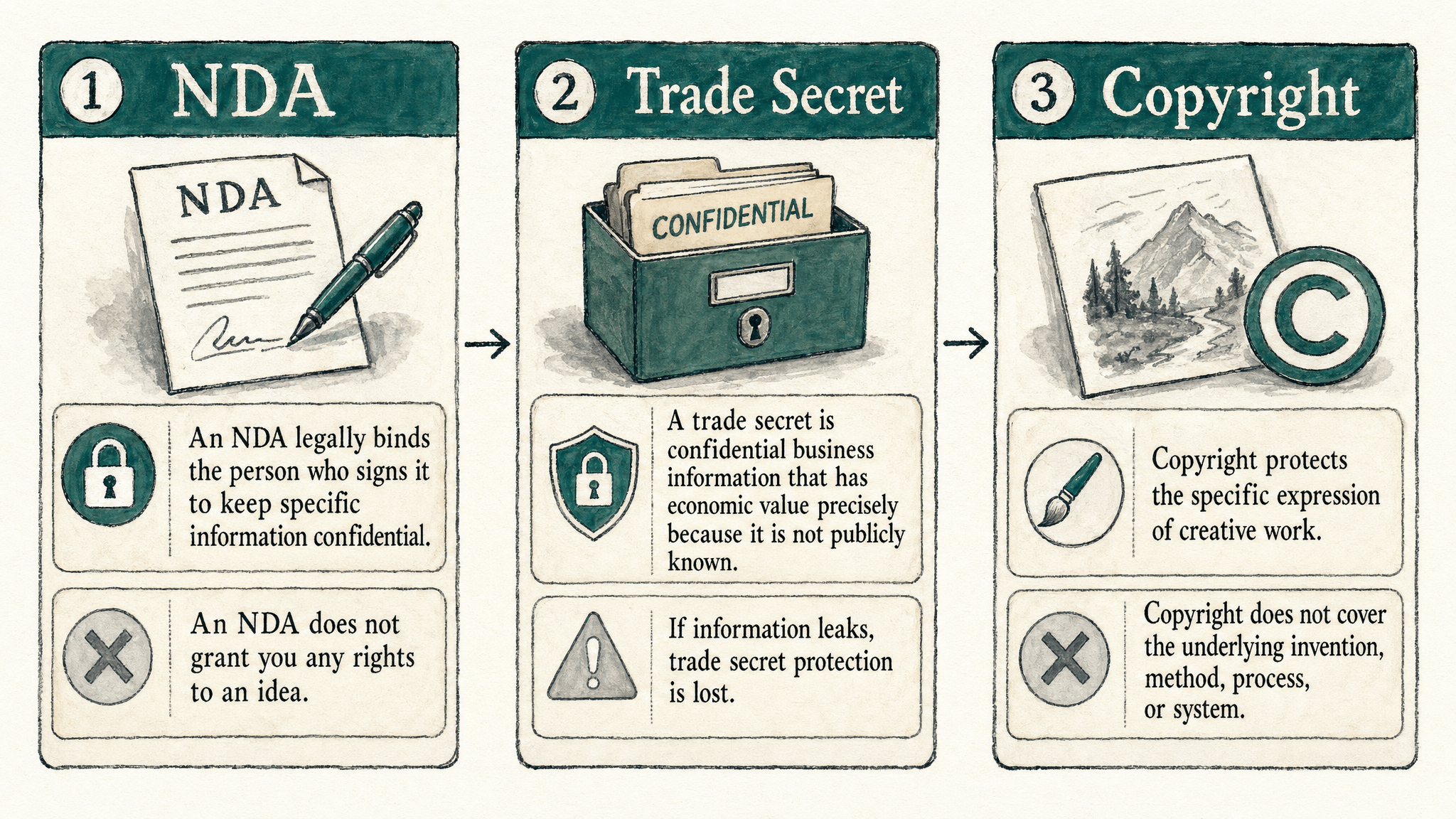
A non-disclosure agreement (NDA) is a contract that legally binds the person who signs it to keep specific information confidential. It does not grant you any rights to an idea. It cannot stop someone who never signed it from developing the same thing independently. And if someone violates it, enforcing the agreement typically requires costly litigation and proof of breach.
NDAs matter most in relationships where you control who enters the room: manufacturing partners, contractors, and employees. In those situations, getting an agreement signed before you share anything is the best practice. The agreement should clearly define what counts as confidential, include realistic time limits, restrict uses like reverse engineering, and carve out information that is already public knowledge. A vague or generic NDA is harder to enforce than one written for the specific relationship.
The investor context is different. Many investors refuse to sign NDAs before an initial pitch, and asking for one can signal inexperience. That does not mean you are unprotected, but it does mean an NDA is the wrong primary tool when pitching to someone who will not sign one. What you share at that stage, and how much detail you include, is a judgment call about disclosure, not a question an NDA can answer for you.
There is also a lighter option worth knowing: an idea disclosure agreement. Before sharing specific details with someone who is not yet a formal partner or contractor, this type of agreement documents that you are sharing proprietary information under a mutual understanding of confidentiality. It is simpler than a full NDA and can be used in early, informal situations where a full agreement feels premature.
Trade secrets: protection that depends on behavior
A trade secret is confidential business information that has economic value precisely because it is not publicly known. Formulas, processes, methods, and proprietary systems can all qualify. What makes trade secret protection work, and what makes it fail, is how consistently you treat the information as secret.
If information leaks, trade secret protection is lost. That means restricting access, using NDAs with anyone who handles the information, and maintaining internal policies that treat sensitive material as genuinely confidential. Trade secret status is not a filing you make; it is a state you actively maintain. Once the information is in the open, you cannot reclaim it.
Copyright's scope, and where it stops
Copyright protects the specific expression of creative work: written plans, original designs, software code, marketing copy, visual materials. What it does not cover is the underlying invention, method, process, or system. A detailed written description of how your product works is protectable as a document; the invention itself is not.
This matters because copyright is often the wrong tool for inventors. As the idea-expression distinction covered earlier makes clear, the law protects how you expressed something, not the functional concept behind it. If what you have created is a new process or device, copyright protects your written description of it, not the thing itself. Patents address inventions; copyright addresses creative expression.
Written plans, design documents, pitch decks, and original visual materials can receive copyright protection, and as established earlier, copyright registration with the U.S. Copyright Office strengthens your enforcement position meaningfully. But that protection stops at the edge of the creative work. It does not extend to the invention those materials describe.
Knowing the tools in the abstract is one thing. Applying them to specific creative and business outputs, where the protection needs vary widely, is where strategy becomes concrete.
Safeguarding Specific Work: Books, Courses, Frameworks and Products
A consultant spent two years refining a six-step client methodology, put it on a slide deck for a conference, and handed it to three hundred attendees with no protection in place before that morning. The tools to prevent that situation exist. Matching them to the right type of creative output is where the gap usually lives.
Product ideas before manufacturer conversations
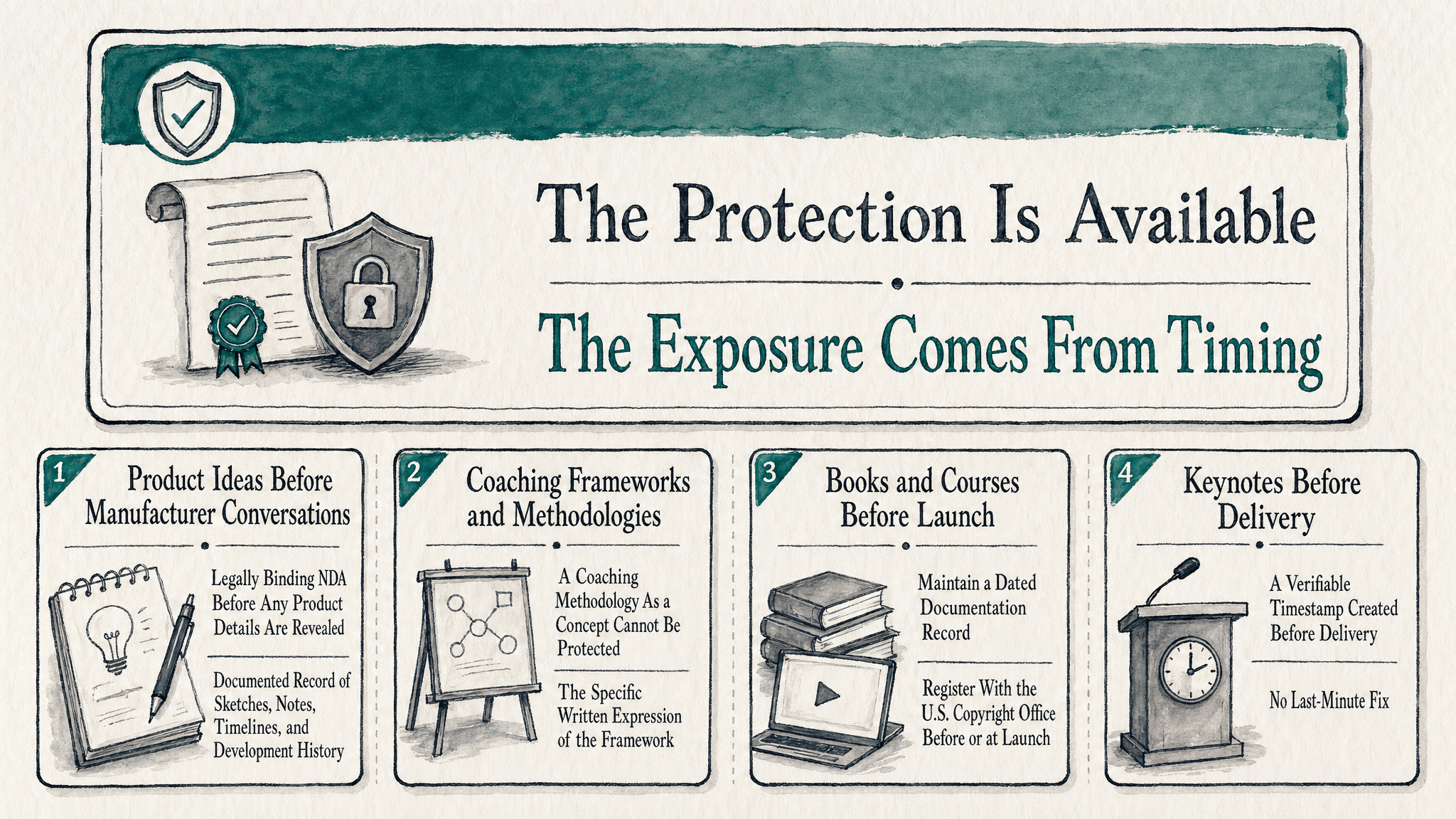
When you're preparing to share a product idea with a manufacturing partner, the NDA established earlier as a confidentiality contract becomes the first requirement, not a formality to handle later. Manufacturers should sign a legally binding NDA before any product details are revealed. Gradual disclosure helps here too: share high-level concepts to establish interest, then provide specifics only after the agreement is in place. Pair that signed NDA with a documented record of sketches, notes, timelines, and development history. That combination creates a paper trail linking the idea to you before any third party sees the substance of it. If the relationship produces improvements to your idea, agreements should also include invention assignment clauses so those improvements stay yours.
Coaching frameworks and methodologies
The idea-expression distinction, covered earlier, applies directly here. A coaching methodology as a concept, the general approach or theory behind it, cannot be protected. The underlying ideas and methods are not eligible for direct IP protection, and patents rarely apply to coaching methods since they are not typically considered inventive processes for patent eligibility purposes. What is protectable is the specific written expression of the framework: the workbook, the slide deck, the documented process, the written description of how each step works. That expression qualifies for copyright the moment it is fixed in tangible form. A key limitation worth understanding: a competitor who develops a similar framework using different names cannot be stopped by copyright alone. The protection covers your specific expression, not the concept of having a structured methodology. This is why documenting the written form thoroughly, and timestamping that documentation before you share it, matters.
Books and courses before launch
Copyright in pre-launch creative work applies automatically to original written expression upon creation, but that automatic protection has practical limits in a dispute. As established earlier, registration with the U.S. Copyright Office creates the public record and strengthens enforcement options in ways that private documentation alone cannot. For a book or course still in development, the protection plan has two components: maintain a dated documentation record of the work as it develops, and register the finished expression before or at launch. Trade secret practices can also apply to proprietary methods embedded in course content while that content remains non-public.
Publisher and Inventor Kary Oberbrunner, created The IP FlywheelIP to help authors understand the proper timeframe for promoting their books, only after protecting their books. This can be done via blockchain solutions like Instant IP.
A written script or detailed slide content is fixed expression the moment it exists in written form, which means copyright applies. The gap creators face is provability: if someone reproduces your keynote material after a conference, your ability to establish that you created it first depends on what you documented and when. A verifiable timestamp created before delivery gives you an independently provable creation date tied to the specific content. Waiting until five minutes before a pitch or presentation reveals the real problem: there is no last-minute fix that creates meaningful protection at that point. The value of earlier timestamping and documentation is that it closes this window before you walk into the room.
Across all of these scenarios, the pattern is consistent. The protection is available. The exposure comes from timing: sharing before documenting, disclosing before agreements are signed, and assuming copyright's automatic attachment is enough without creating the verifiable record that makes it enforceable. Matching your specific output to the right combination of documentation, agreements, and registration, before you share it with anyone, is the practical outcome of understanding these tools in context.
For situations where you need a timestamped record that is tamper-evident and independently verifiable, blockchain-based tools offer a different kind of proof mechanism worth understanding on its own terms.
How Blockchain Timestamping Works for IP
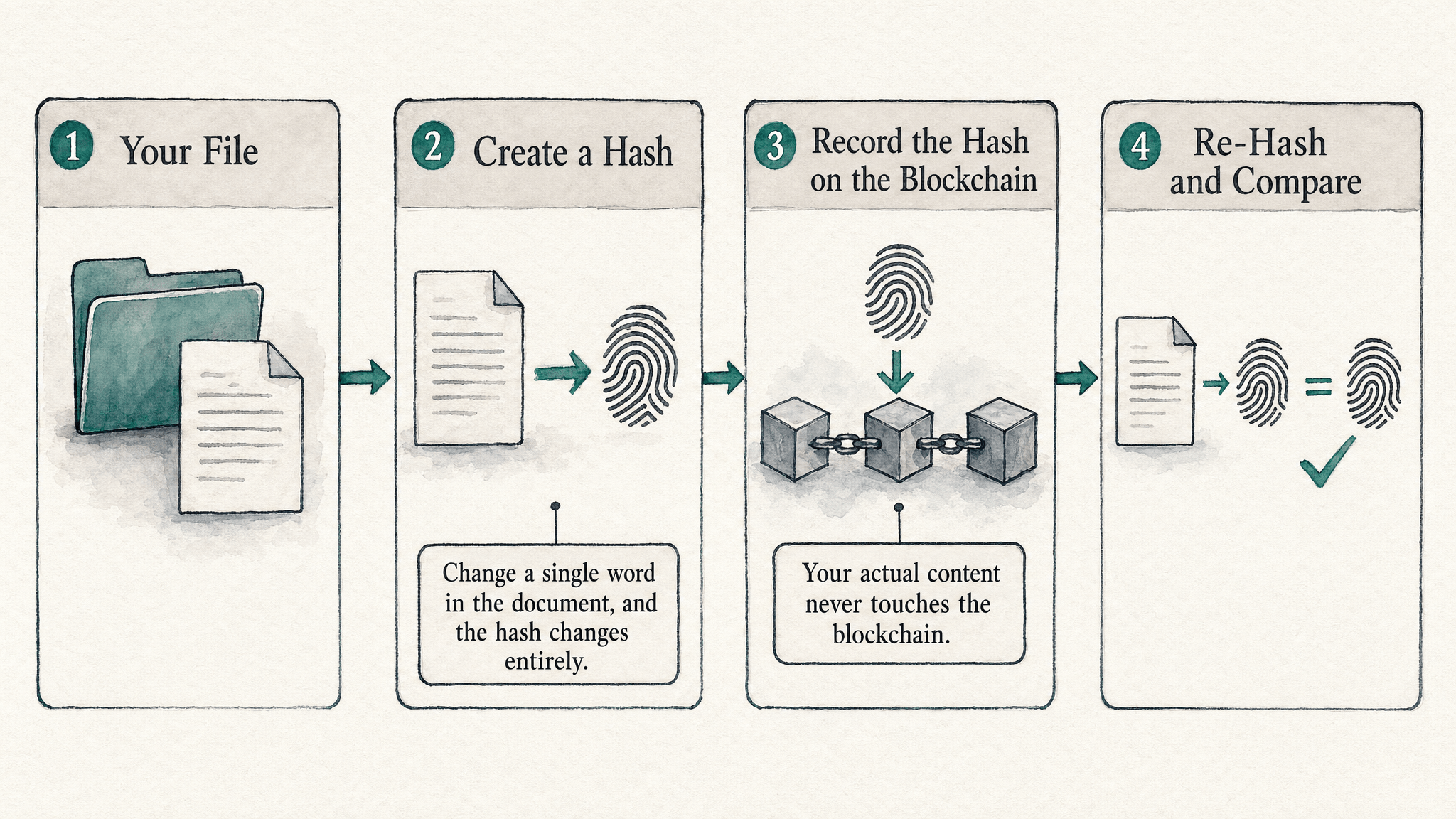
Blockchain timestamping works by converting your file into a unique cryptographic fingerprint, called a hash, and recording that fingerprint permanently in a public ledger at a specific moment in time. Your actual content never touches the blockchain. Only the hash does. That distinction matters, because it means your file stays private while the proof becomes public and permanent.
What a hash actually is
A hash is a fixed-length string of characters generated by running your file through a cryptographic algorithm. Change a single word in the document, and the hash changes entirely. Two different files cannot produce the same hash. This is what makes the fingerprint tamper-evident: anyone who later disputes whether a file was modified can run the same algorithm on the current version and compare the output. If the hashes match, the file is identical to what existed at the recorded moment. If they don't, something changed.
What a blockchain timestamp proves
A blockchain timestamp proves that a specific file existed in its exact form before the block containing its hash was recorded on the chain. It does not prove the precise second of creation, but the boundary it establishes, existence before a publicly verifiable block, is sufficient for most legal and compliance contexts. The record is permanently embedded in the chain's structure. Changing any entry in a blockchain would require rewriting every subsequent block, which is why the structural integrity holds. That integrity is why blockchain proofs have been used in legal settings to establish that documents predated a competing party's filing.
The permanence also extends beyond the service that created the record. Because the hash is written to the blockchain itself, rather than stored on a private server, the record remains intact even if the company you used to generate it closes. This is a meaningful practical difference from timestamping methods that depend on a third party staying in business to verify your proof.
Hash-based verification in practice
Verification works the same way the original hash was created. Take the file, run it through the same algorithm, and compare the resulting hash to what is recorded on the blockchain. Because blockchains are public, anyone with access to the original file and basic tools can perform this check independently, without going through the service that generated the timestamp. That independent verifiability is what separates blockchain timestamping from self-attested records or methods that require a specific intermediary to confirm.
Version timestamping for iterative work
Because every version of a file produces a different hash, blockchain timestamping applies naturally to work that evolves over time. Timestamp a rough description of your invention in its early form, then timestamp the refined version three months later when the design changed, then again when you added technical specifications. Each hash is distinct, and each timestamp is independently recorded. The result is a documented progression of creation, a chain of dated snapshots that reflects how your idea actually developed rather than a single moment you might struggle to pin down later.
This version-level timestamping is particularly useful for iterative creative work: a product in development, a manuscript going through drafts, a software architecture that shifts over months. Each timestamp creates a fixed point in the timeline, and together they tell a coherent, verifiable story of prior creation.
Blockchain timestamping does not replace copyright registration or patent filing. Those formal processes carry their own legal weight and enforcement mechanisms. What a blockchain timestamp provides is a first layer: independently verifiable, tamper-evident, and permanent, regardless of where you are in the development process or whether you are ready to file anything formally.
Understanding how the mechanism works is one part of the decision. The practical questions around cost, speed, privacy, and what happens if a provider closes are the other part, and those deserve their own clear answers.
Blockchain IP Services: Cost, Speed, Privacy and Reliability
Knowing how blockchain timestamping works puts you in a better position to evaluate the services that offer it. The mechanics matter, but so do the practical questions: what does it cost, how quickly does it work, what happens to your confidential content, and what becomes of your record if the company you used eventually closes? Those four questions should guide any comparison.
Cost and speed
Blockchain IP services vary in pricing.
Instant IP's blockchain service for idea documentation comes in under $100, which positions it as a low-cost option relative to the timeline and expense of formal patent prosecution.
Speed is less variable across services than cost is. Blockchain transactions are generally fast, but the practical question is whether the service provides a usable certificate or verifiable record immediately after submission, or if there is a delay in confirmation. A timestamp that takes days to confirm is less useful when you need to document something before a meeting or pitch.
Hash-only submission as a privacy mechanism
When you submit a file to a blockchain IP service, what actually gets recorded on the public ledger is the hash of your file, not the file itself. That is the standard approach described earlier for how blockchain timestamping works. Hash-only submission as a privacy mechanism means the service is specifically designed so that your original content never leaves your control. The service receives or generates the hash, writes it to the chain, and your document stays entirely on your end.
This matters because the public ledger is readable by anyone. If a service uploaded your actual document rather than just its hash, your confidential idea would be accessible. Hash-only submission closes that gap. What is public is only a cryptographic fingerprint that proves existence but reveals nothing about content. When evaluating a service, confirm explicitly that it follows this model. Reputable IP-focused blockchain services treat it as standard, but the privacy policy and technical documentation for the specific service should confirm it.
Provider-independence of the on-chain record
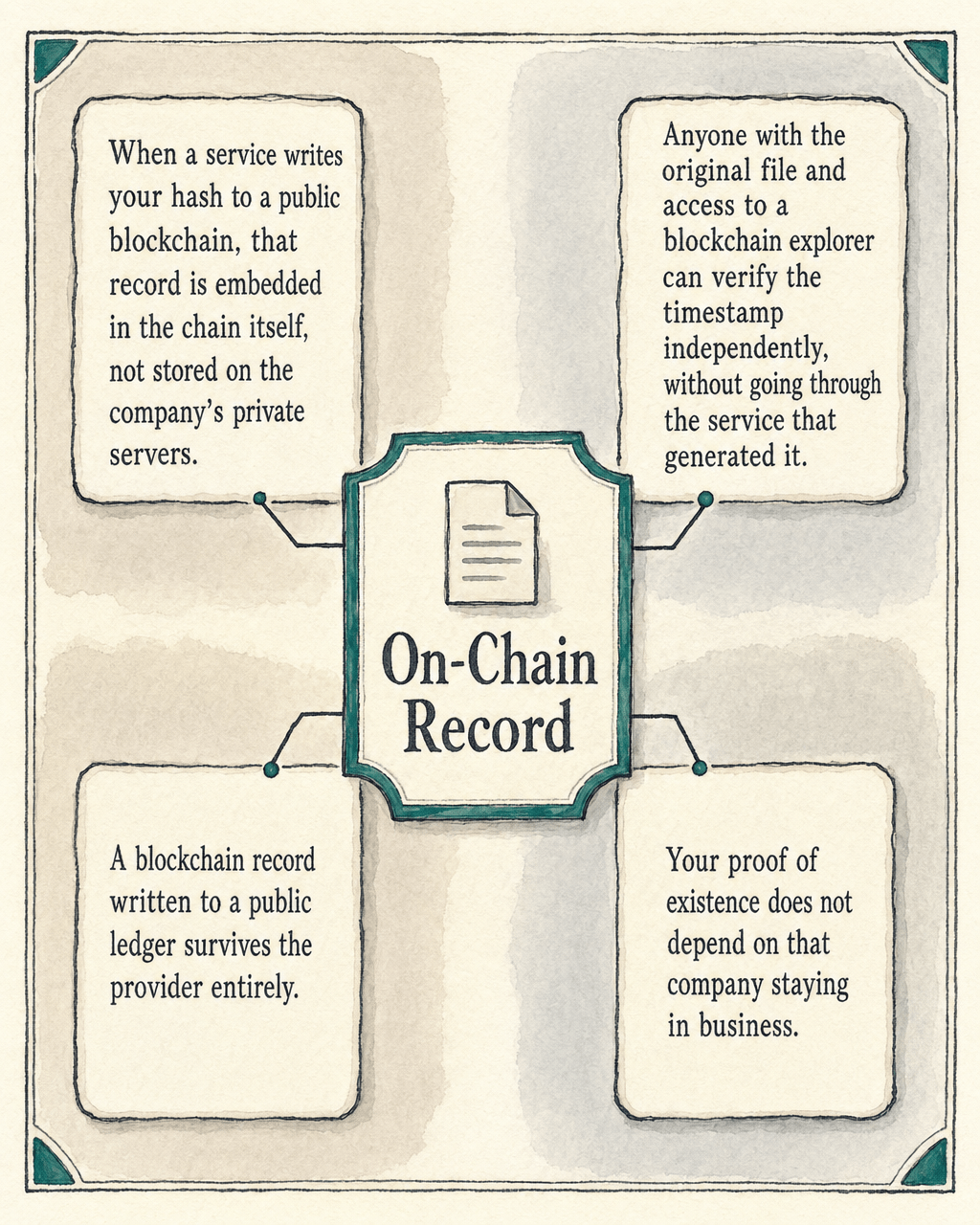
This is the criterion most creators overlook. When a service writes your hash to a public blockchain, that record is embedded in the chain itself, not stored on the company's private servers. Provider-independence of the on-chain record means your proof of existence does not depend on that company staying in business. Because blockchains are public, anyone with the original file and access to a blockchain explorer can verify the timestamp independently, without going through the service that generated it.
The contrast with server-dependent records is important. If a company stores your documentation on its own infrastructure and then closes, those records may become inaccessible. A blockchain record written to a public ledger survives the provider entirely. When evaluating a service, ask two questions: which blockchain does it use, and can you verify the record independently using a public blockchain explorer without the company's help? If the answer to the second question is yes, your proof survives the service relationship.
Authenticity in legal contexts
Courts evaluating blockchain records focus on whether those records meet established legal standards for authenticity and integrity, specifically whether the record is free from tampering and whether its origin is identifiable. Technical immutability strengthens evidentiary value, but courts weigh legal authenticity as the operative standard. A blockchain IP service that generates a clear audit trail, shows which file was hashed, when the hash was submitted, and on which chain it was recorded, gives you a more defensible record than one that simply outputs a transaction ID with no accompanying documentation.
The four criteria together, cost, speed, privacy through hash-only submission, and provider-independence, form the practical checklist for choosing a service that will still be useful if you ever need to rely on it.
Legal Standing of Blockchain Timestamps in Court
The provider-independence and audit trail criteria from the prior section determine whether a record holds together. What happens when that record enters a courtroom depends on where you are.
Blockchain evidence admissibility by jurisdiction refers to the rules, rulings, and statutes that govern whether a blockchain-recorded proof can be accepted in legal proceedings. The answer varies considerably by country, and the legal landscape has shifted enough in recent years that the question carries real practical weight.
Where courts have ruled
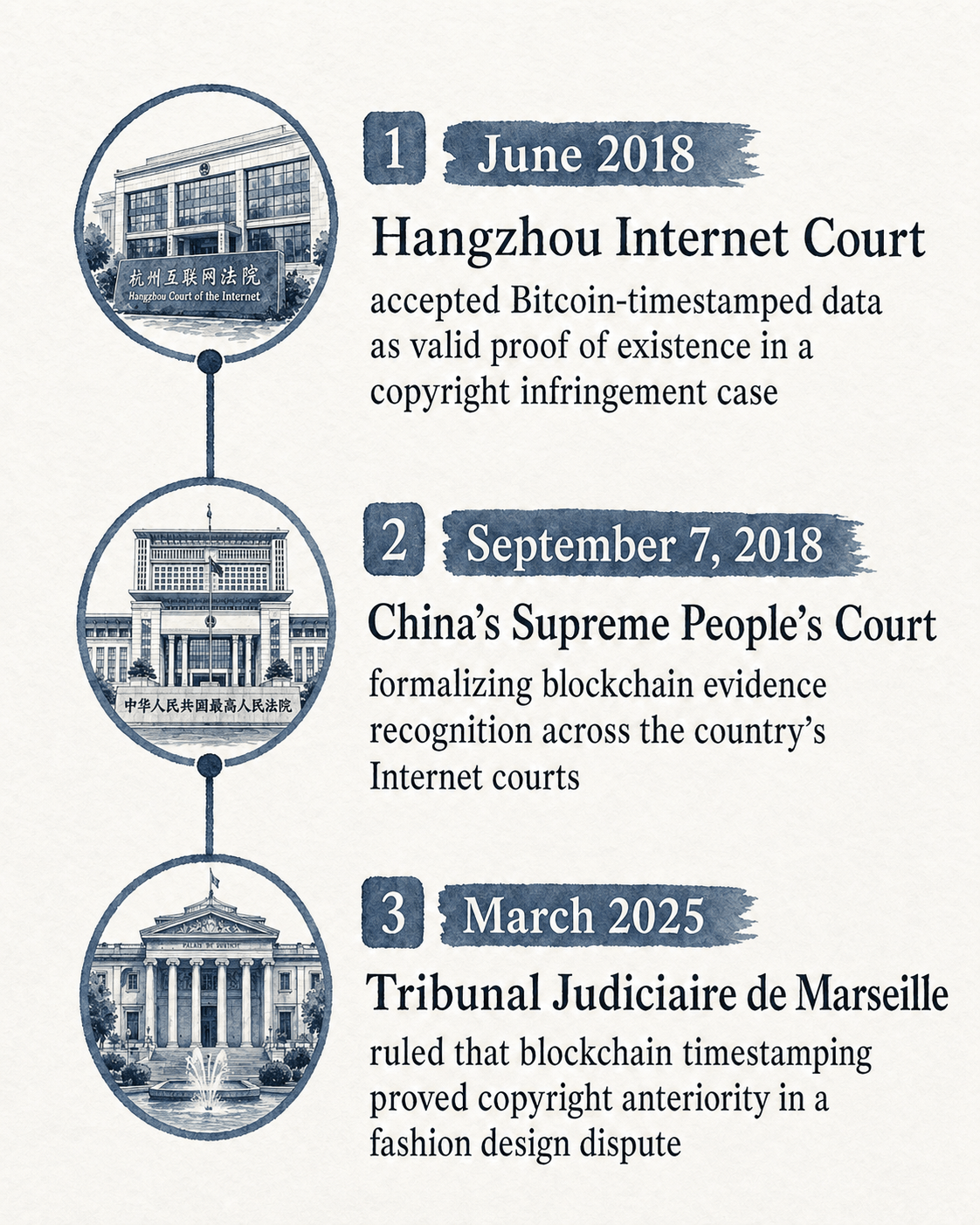
China moved first. The Hangzhou Internet Court accepted Bitcoin-timestamped data as valid proof of existence in a copyright infringement case in June 2018, widely regarded as the first formal court validation of blockchain for evidence storage globally. China's Supreme People's Court followed on September 7, 2018, formalizing blockchain evidence recognition across the country's Internet courts. The Hangzhou court itself operates judicial blockchain platforms integrated into its proceedings.
France reached its own milestone in March 2025. The Tribunal Judiciaire de Marseille ruled that blockchain timestamping proved copyright anteriority in a fashion design dispute, the first ruling of its kind in Europe. The court recognized blockchain timestamps, when certified by a bailiff, as reliable evidence for establishing IP ownership and creation dates. France now treats blockchain as a legitimate tool for proving anteriority in copyright disputes.
The European legislative framework
The eIDAS framework is the EU regulation (No. 910/2014) that governs electronic identification and trust services across member states. Under eIDAS, qualified electronic timestamps carry a legal presumption of accuracy and are admissible across the EU. Italy went further with a specific national codification: Law No. 12/2019, Article 8-ter, grants blockchain timestamps the same legal effect as eIDAS-compliant electronic timestamps. That statutory equivalence means Italian courts treat a blockchain timestamp with the same standing as any other qualified electronic timestamp under EU law. Adoption through this eIDAS pathway has grown across the EU, with Italy's statute representing the clearest national codification to date.
The U.S. position
The U.S. has no single federal statute equivalent to Italy's codification, but the existing federal evidentiary framework accommodates blockchain records. Federal Rules of Evidence 902(13) and 902(14), amended in 2017, support the self-authentication of electronic records, including blockchain-like records. A properly documented blockchain record can be introduced without a live witness to authenticate it. At the state level, Arizona's HB 2417 provides that blockchain records and signatures may not be denied legal effect, validity, or enforceability, and Vermont allows blockchain receipts accompanied by a written declaration to be admitted in court. Individual states retain authority to set their own rules, and federal comprehensive legislation has not yet been enacted. A 2024 U.S. District Court ruling found that blockchain analytics tools met evidentiary reliability standards under the Daubert framework, signaling that courts are prepared to evaluate blockchain-based records on their technical merits.
Blockchain timestamps versus notarized documents
The blockchain timestamp proof and independent verifiability concepts covered earlier shape how these records compare to notarized documents in a legal context. Notarized documents prove a different set of things: signer identity, voluntary intent, and document execution at a specific time. That clarity gives them reliable standing in most courts, particularly in civil law systems where traditional notaries hold formal precedence. A blockchain timestamp, by contrast, proves that a specific file existed in its exact form before a block was recorded on a public ledger, and that proof does not depend on any revocable credential or intermediary. The comparative weight of each depends on the jurisdiction and the legal question being answered. Where greater legal strength is needed, pairing blockchain timestamps with additional authorities, such as a certified bailiff or RFC 3161-compliant timestamps, can reinforce the record depending on local requirements.
Blockchain timestamps establish prior possession in an expanding number of jurisdictions. When the goal shifts from documenting existence to securing enforceable exclusive rights, the patent system is the mechanism built for that purpose, with its own costs, timelines, and realities worth examining carefully.
Patents: Process, Costs, Timelines and Approval Rates
Blockchain timestamps establish prior possession in an expanding number of jurisdictions. When the goal shifts from documenting existence to securing enforceable exclusive rights, the patent system is the mechanism built for that purpose, with its own costs, timelines, and realities worth examining carefully.
An inventor files a patent application expecting a yes-or-no answer within a few months. Two years later, she is still in examination, responding to her second office action, and her original cost estimate has nearly doubled. That scenario is not unusual. It is, in fact, a fairly common experience for first-time applicants who entered the process without a clear picture of what patent prosecution actually involves.
The two-step path: provisional and non-provisional
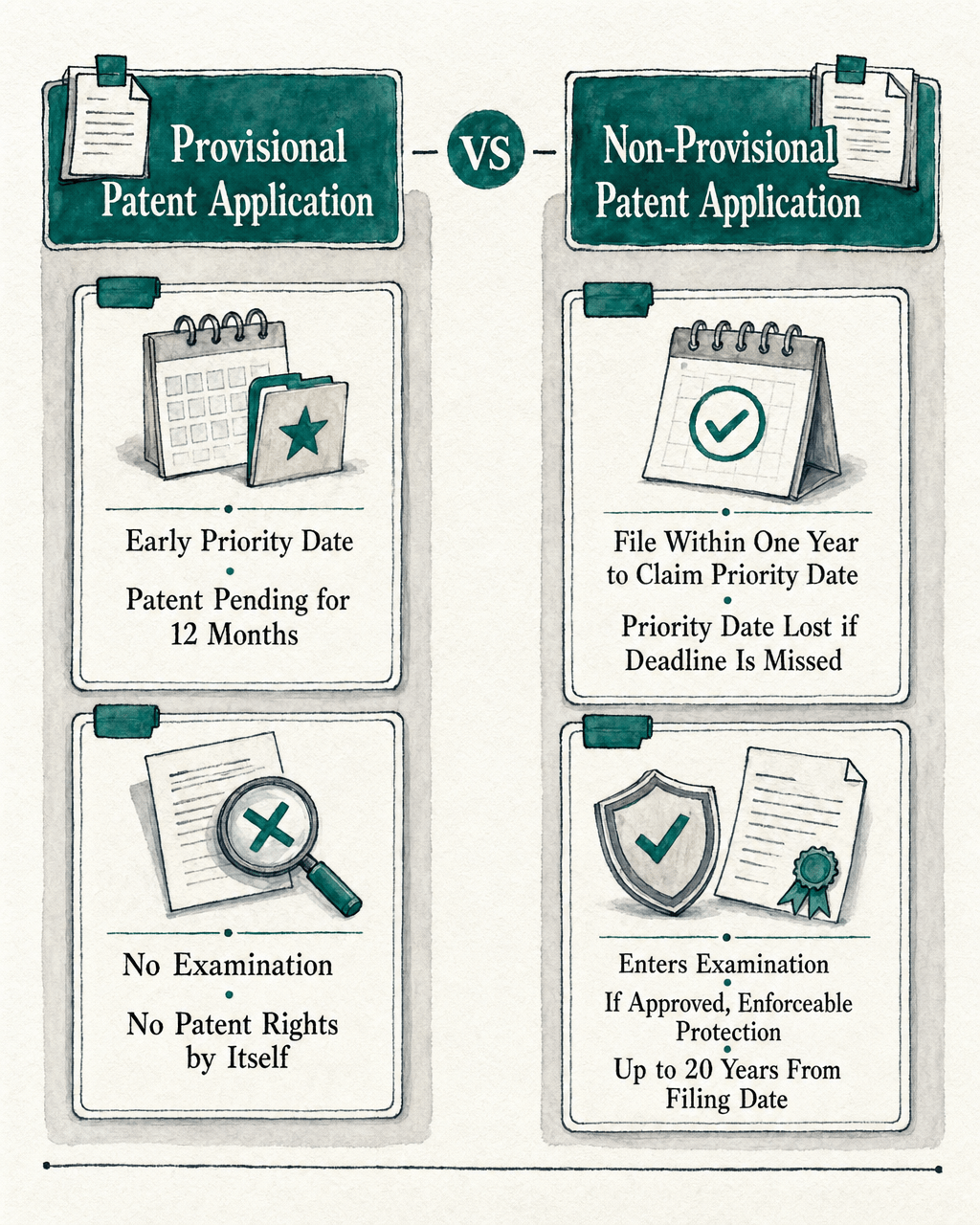
A provisional patent application is a formal filing with the USPTO that establishes an early priority date and grants "patent-pending" status for 12 months. It does not undergo examination, and it does not by itself grant any patent rights. What it does is buy time: time to refine the invention, conduct market research, and decide whether pursuing full protection makes sense before committing to the higher cost of a non-provisional filing. For early-stage inventions that still need development, a provisional is a reasonable first step.
The 12-month window is firm. A non-provisional patent application, which is the formal submission that actually enters examination, must be filed within one year of the provisional to claim its priority date. Miss that deadline, and the priority date is lost. If approved after examination, a non-provisional patent can provide enforceable protection lasting up to 20 years from the filing date.
One practical risk in this two-step path is quality. A skeletal provisional that captures a rough concept rather than a detailed description of the invention may not adequately support the claims needed when the non-provisional is filed 12 months later. The provisional sets the ceiling for what the non-provisional can claim as its priority date. Writing a thin provisional to file quickly, then trying to broaden it at the non-provisional stage, is a common and costly mistake.
What it costs and how long it takes
Patents are generally the most expensive form of IP protection. The total cost involves two layers: USPTO filing fees, which vary based on entity size, and attorney fees for drafting, prosecution, and responses to office actions. USPTO government fees are 50 to 80 percent lower for small or micro entities compared to large entities, which matters for independent inventors and early-stage founders. Attorney and agent fees are typically the dominant cost factor overall, and those fees depend heavily on technology area and application complexity. Patent maintenance fees also add ongoing expenses across the life of the patent.
Timelines vary by technology area and USPTO workload. Patents are generally the slowest form of IP protection to obtain. First-office-action rejections are common, and most applications require at least one response before allowance. The "real approval rate" question is genuinely nuanced: an initial rejection does not mean the application fails, since many applications eventually receive a patent after prosecution. For current approval rate data, the USPTO publishes technology-specific statistics directly. Unfortunately, the USPTO is currently backlogged 800,000 patents.
Where patents fit relative to other tools
Patents provide stronger and more comprehensive protection than blockchain timestamping. A blockchain timestamp, as covered earlier, proves that a specific file existed at a point in time before a block was recorded. That is a different function entirely. A patent grants the holder exclusive rights to make, use, and sell the invention for its duration. Those are enforceable monopoly rights, not simply proof of prior existence.
The tradeoff is cost and time. Blockchain timestamping is a first layer of documentation, not a substitute for patent rights. However, blockchain timestamping is prior art. Simply put, if you timestamp your idea, you can invalidate a patent application someone else files after you. Patents are only granted if an invention is novel and non-obvious. By providing a timestamp of the same invention, you demonstrate that the other person’s patent is no longer novel or non-obvious. Patents are the right tool when the goal is exclusive enforcement, and the process rewards applicants who enter it with realistic expectations about what the examination process actually looks like.
Patent Law and First-to-File Strategy
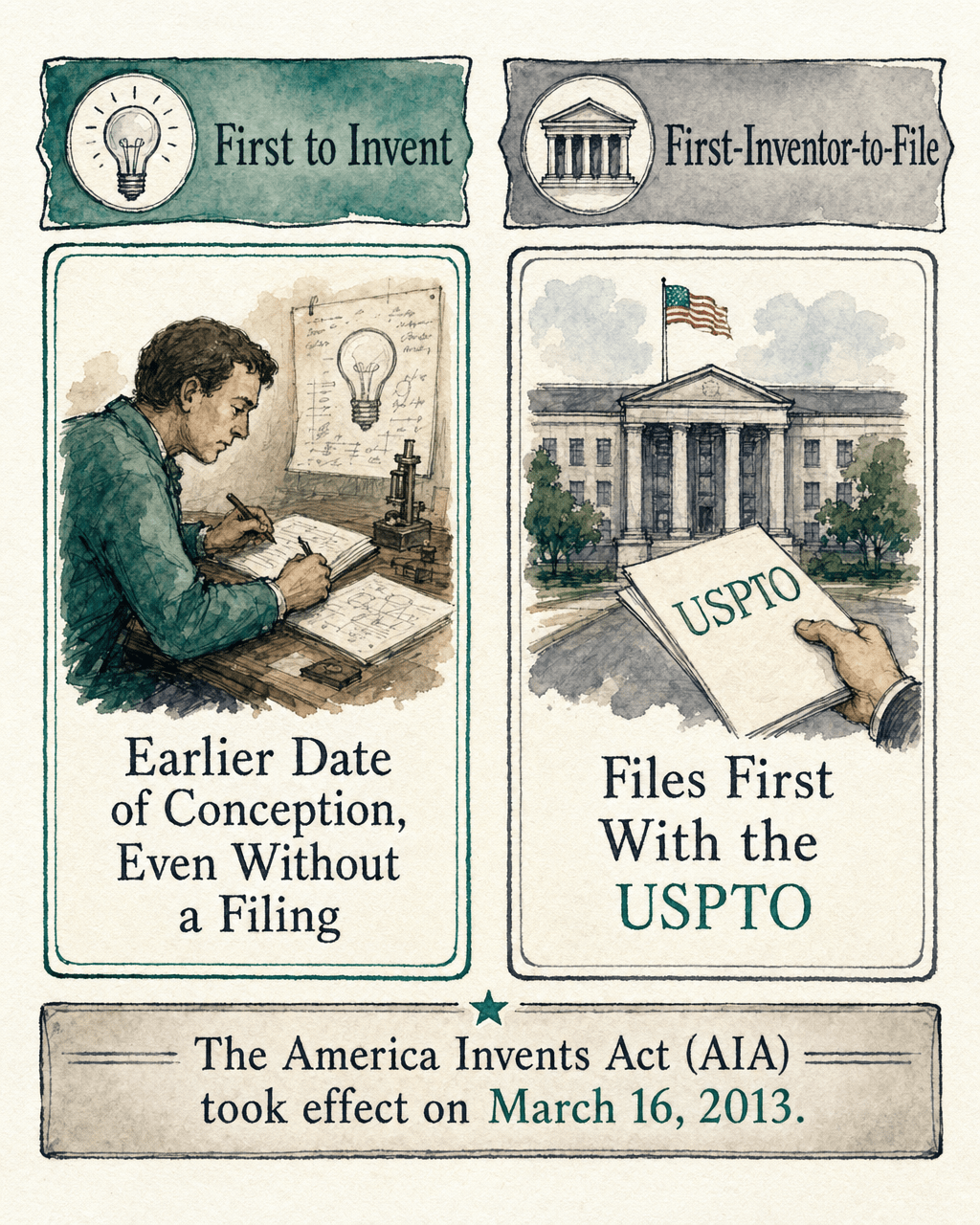
The previous section ended with patents established as the right tool for enforceable exclusive rights. What the patent system does not always make clear is how dramatically the rules about who gets those rights changed over a decade ago, and why that change should influence every decision you make about timing.
The America Invents Act (AIA) took effect on March 16, 2013, and with it, the U.S. shifted from a "first to invent" system to a "first-inventor-to-file" system. Before that date, if two inventors independently developed the same invention, priority could go to whoever demonstrated the earlier date of conception, even without a filing. Under the current system, priority goes to whoever files first with the USPTO. Full stop.
Consider two engineers who independently develop the same device. One has a detailed lab notebook documenting two years of development. The other filed a provisional application three weeks ago. Under current U.S. law, the engineer with the lab notebook faces a steep climb. A documented record of prior invention, no matter how thorough, does not override the other party's earlier filing date. Prior art, in the patent context, refers to any evidence that an invention was known or used before a patent application's effective filing date. Under the first-inventor-to-file system, the person who files first establishes the relevant date, and prior proof of invention in the inventor's own records cannot overcome it.
Filing date is the strategic variable
The practical consequence is straightforward: filing early is not optional if patent protection is the goal. The approach that patent practitioners recommend, and that the AIA made structurally necessary, is to file provisional applications early and often. As covered earlier, a provisional application establishes a priority date and grants "patent-pending" status for 12 months, buying time to refine the invention before committing to a full non-provisional filing. Missing that 12-month window forfeits the provisional's priority date entirely, with no extension available.
Delaying a filing increases the risk that someone else files first. That risk is not theoretical. Two people can independently arrive at the same idea, and under the AIA, the one who acts sooner wins.
Public disclosure and the 12-month grace period
The AIA includes a 12-month grace period, but its limits are easy to misread. The U.S. grace period allows an inventor who publicly discloses their own invention to still file a patent application within 12 months of that disclosure. After that 12-month window closes, the invention becomes prior art, and the inventor loses the right to file.
The more significant problem is disclosure by others. Disclosures made by third parties before your filing date can bar your application from patentability, even if you are within the grace period for your own prior disclosures. The safest position is to file before any public disclosure, not after. Waiting until after a pitch, a conference, or a public demonstration introduces risk that the grace period cannot always cure.
Where blockchain timestamping fits
The first-inventor-to-file system does not eliminate the value of a documented record. A blockchain timestamp establishes prior possession of an idea and can support dispute context, particularly in non-patent matters like copyright priority or trade secret disputes. What it does not do is substitute for an actual patent filing when enforceable patent rights are the goal.
The two tools address different questions. A blockchain timestamp answers: did this file exist, in this exact form, before this date? A patent filing answers: who gets the exclusive right to this invention? Under the AIA, the second question is resolved by filing date, and no amount of prior documentation changes that structural requirement.
Choosing the Right IP Protection: Comparisons and Strategy
Documentation and timestamping create a credible record. But when patent protection is what a creator or founder actually needs, that record matters far less than the date on the USPTO filing.
That gap between what each tool actually does and what creators assume it does is where most IP mistakes happen. The real question was never which protection option sounds most official. It's which one fits your specific type of work, your timeline, and what you actually need it to do.
A tool-matching decision framework anchors each choice to four practical questions: What kind of work is this? What rights do you need? How urgent is protection? And what can you realistically invest right now?
Patents, blockchain timestamps, and NDAs: applying the comparison
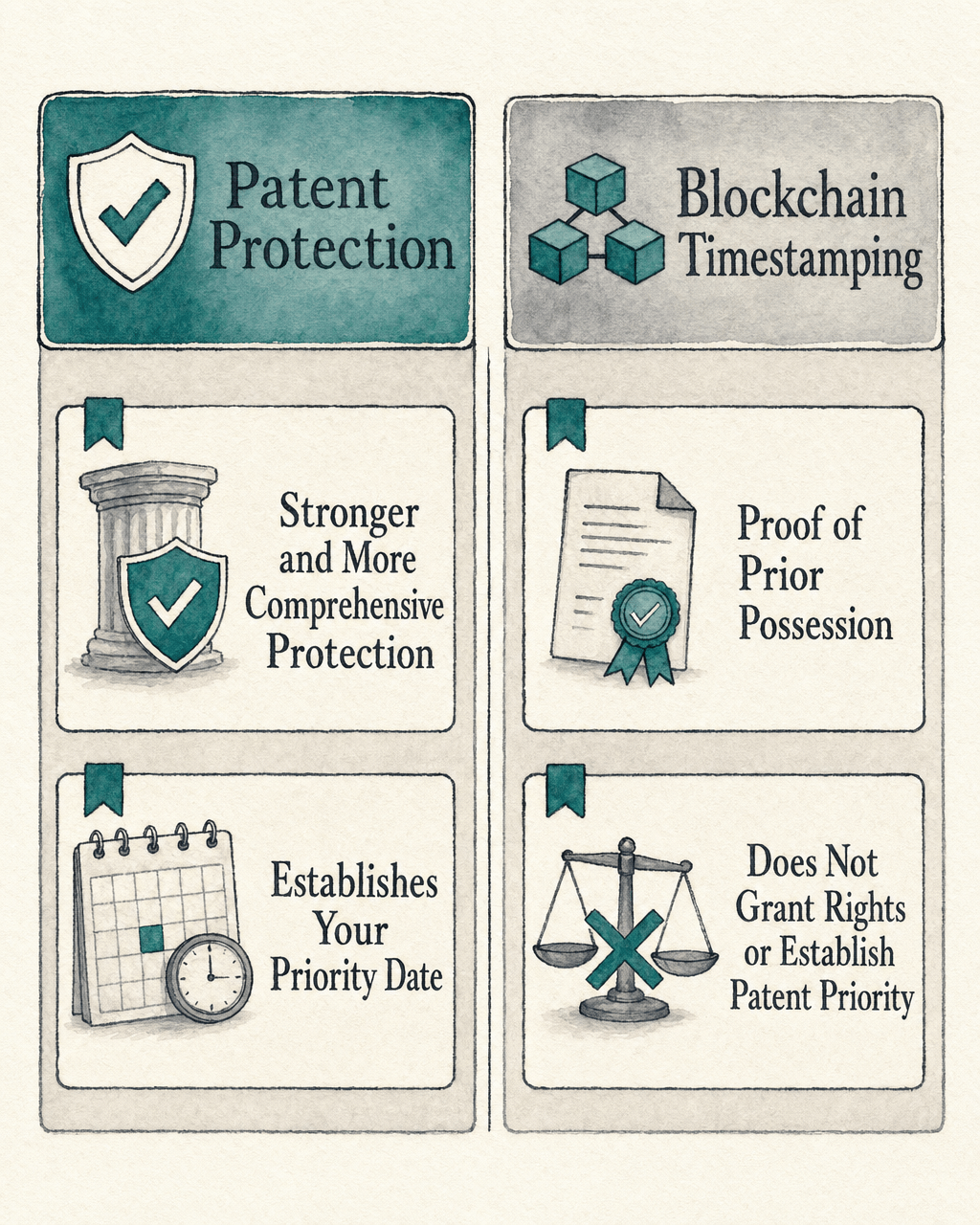
Patents provide stronger and more comprehensive protection than blockchain timestamping, but that strength comes with a corresponding cost in time and money. A provisional patent establishes your priority date and buys 12 months to refine the invention before committing to full prosecution. If you intend to commercialize and monopoly rights matter, that filing should come early. Where a trade secret would better preserve competitive edge long-term, patenting may not be the right move at all, since filing makes the invention public.
A blockchain timestamp is a low-cost, fast, independently verifiable proof of prior possession. It does not grant rights or establish patent priority. For inventors who need an immediate dated record while preparing a provisional, or creators who want documented proof before sharing work, that first layer has real practical value. Starting with blockchain timestamping and later filing a provisional is a reasonable sequence for that reason.
NDAs bind the person who signs them, but they cannot stop an independent party who never signed one. They matter most in manufacturing and contractor relationships. Investors rarely sign them before an initial pitch, and combining NDAs with patents is sound practice when disclosures require both confidentiality and formal rights protection.
Matching the tool to the situation
For expressive work like books, frameworks, and courses, copyright registration combined with blockchain timestamping covers most practical scenarios. Copyright registration creates a public record with a strong legal presumption of ownership. A blockchain timestamp adds a pre-disclosure proof record. Together, those two layers address what creators whose work is primarily expressive actually need.
For inventions, the central questions are whether you intend to commercialize and whether exclusive rights matter. If yes to both, a provisional patent filing should come first, supported by thorough documentation and a timestamp during the development phase.
For work not yet built, the path is straightforward: keep it confidential, document it thoroughly, use a blockchain timestamp to create a dated record during that documentation phase, and consider a provisional patent if it qualifies as an invention worth protecting with exclusive rights.
If you have already disclosed publicly, the first-inventor-to-file system and its grace period limits make that a timing decision that cannot be undone. The safest position remains filing before any public disclosure.
The clearest dividing line
Being first to market creates competitive advantage, but it does not substitute for IP protection when enforceable rights are the goal. Market position and legal rights are different things, and the tool-matching decision framework exists precisely to keep that distinction clear: copyright and timestamping for expressive work, patents for inventions with commercial intent, NDAs for relationships where confidentiality can be contractually enforced. No single tool covers every situation, and defaulting to whichever option sounds most official is how creators end up with the wrong one.
The tool-matching decision framework covered in the prior section exists because no single IP protection mechanism covers every situation. What you actually need depends on what you're protecting, when you're protecting it, and what rights matter most.
Copyright protects specific written expression, not the underlying idea. It attaches automatically when original work is fixed in tangible form, but formal registration with the U.S. Copyright Office creates the public record and strengthens enforcement options in ways that private documentation alone cannot. For books, courses, frameworks, keynotes, and similar creative output, copyright paired with a verifiable timestamp and formal registration gives you the most defensible position.
Blockchain timestamping is a first layer of proof, independently verifiable, tamper-evident, and permanent. It establishes that a specific file existed in its exact form before a block was recorded on a public ledger. What it does not do is grant rights, establish patent priority, or substitute for formal filings. Its value is in the speed and permanence of that documented record, particularly at early stages when formal filing may not yet be practical or warranted.
NDAs bind the person who signs them. They work best in manufacturing and contractor relationships where you control who enters the conversation before anything confidential is shared. They cannot stop an independent party who never signed one, and combining an NDA with a documented record of development history gives the agreement more substance if you ever need to enforce it. Investors rarely sign NDAs before an initial pitch, and that limitation is worth understanding before you rely on one as your primary protection strategy.
Patents grant exclusive legal rights to prevent others from making, using, selling, or importing an invention. They are the most expensive and time-consuming form of IP protection, but for inventions with genuine commercial intent, they are also the most comprehensive. The America Invents Act changed the foundational rule: under the first-inventor-to-file system, priority goes to whoever files first with the USPTO, not to whoever invented first. A documented record of prior invention, no matter how thorough, does not override an earlier filing date. Filing early, often by way of a provisional application that establishes a priority date and secures patent-pending status, is not a refinement of strategy. It is a structural requirement.
The practical takeaway across all of these tools is that timing determines whether your protection holds. Sharing before documenting, disclosing before agreements are signed, and relying on automatic copyright without creating a verifiable record are the patterns that leave real gaps. The safest position on the patent side is filing before any public disclosure, not after. On the copyright side, registration before or at launch positions you to enforce what you created.
Keeping an idea confidential while you get the right documentation in place is the most immediate step available to any creator or founder. After that, the choice of tools follows from the nature of the work: copyright and timestamping for expressive output, patents for inventions where exclusive rights matter, NDAs for relationships where confidentiality can be contractually enforced, and trade secret practices where controlled access is the better long-term strategy.
The question was never which protection option sounds most official. It is which one fits your specific situation right now, and whether you acted in time for it to matter.